- Which abstractions does Dask offer?
- Which programming patterns exist in the parallel universe?
- Recognize
map,filterandreductionpatterns. - Create programs using these building blocks.
- Use the
visualizemethod to create dependency graphs.
In computer science bags are unordered collections of data.
In Dask, a bag is a collection that gets chunked
internally. Operations on a bag are automatically parallelized over the
chunks inside the bag.
Dask bags let you compose functionality using several primitive
patterns: the most important of these are map,
filter, groupby, flatten, and
reduction.
Discussion
Open the Dask
documentation on bags. Discuss the map,
filter, flatten and reduction
methods.
In this set of operations reduction is rather special,
because all operations on bags could be written in terms of a
reduction.
Operations on this level can be distinguished in several categories:
- map (N to N) applies a function one-to-one on a list of arguments. This operation is embarrassingly parallel.
- filter (N to <N) selects a subset from the data.
- reduction (N to 1) computes an aggregate from a sequence of data; if the operation permits it (summing, maximizing, etc), this can be done in parallel by reducing chunks of data and then further processing the results of those chunks.
- groupby (1 bag to N bags) groups data in subcategories.
- flatten (N bags to 1 bag) combine many bags into one.
Let’s see examples of them in action.
First, let’s create the bag containing the elements we
want to work with. In this case, the numbers from 0 to 5.
import dask.bag as db

bag = db.from_sequence(['mary', 'had', 'a', 'little', 'lamb'])
{: .source}
Map
A function squaring its argument is a mapping function that
illustrates the concept of map:
# Create a function for mapping
def f(x):
    return x.upper()

# Create the map and compute it
bag.map(f).compute()
out: ['MARY', 'HAD', 'A', 'LITTLE', 'LAMB']We can also visualize the mapping:
# Visualize the map
bag.map(f).visualize()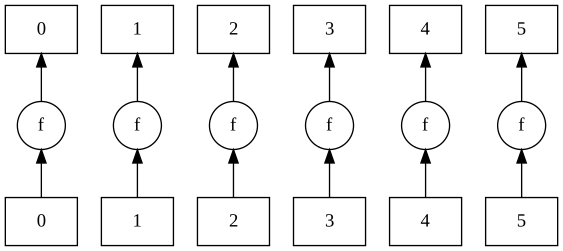
Filter
We need a predicate, that is a function returning either true or
false, to illustrate the concept of filter. In this case,
we use a function returning True if the argument contains
the letter ‘a’, and False if it does not.
# Return True if x contains the letter 'a', else False
def pred(x):
    return 'a' in x

bag.filter(pred).compute()
[out]: ['mary', 'had', 'a', 'lamb']Difference between filter and map
Forecast the output of bag.map(pred).compute() without
executing it.
Solution
Solution
The output will be [True, True, True, False, True].
Reduction
def count_chars(x):
    per_word = [len(w) for w in x]

    return sum(per_word)

bag.reduction(count_chars, sum).visualize()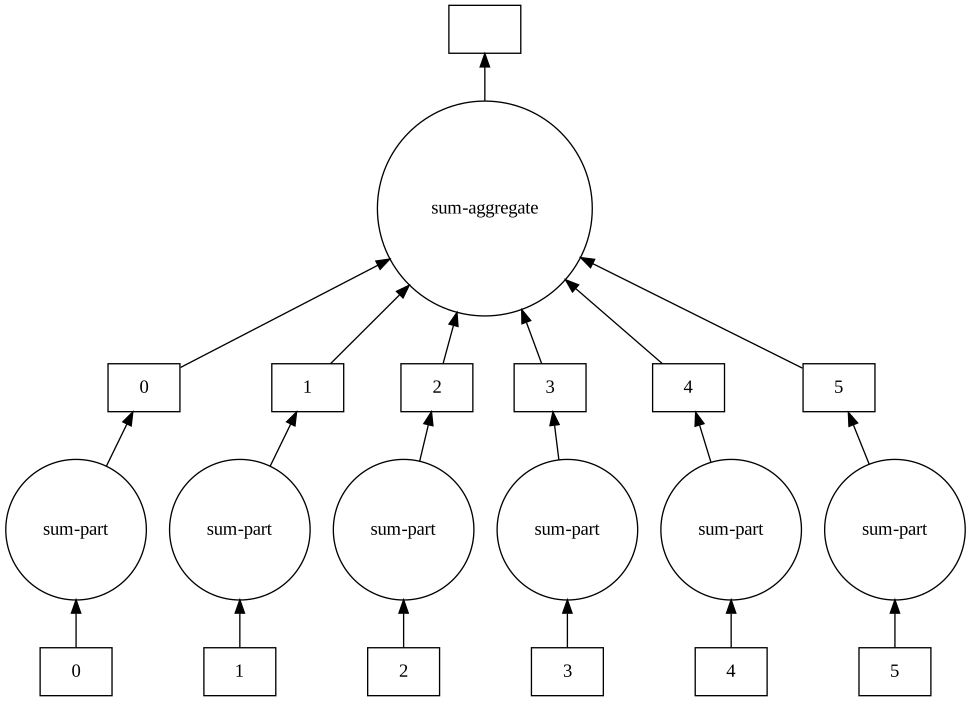
Challenge: consider pluck
We previously discussed some generic operations on bags. In the
documentation, lookup the pluck method. How would you
implement pluck if it was not there?
Hint: Try pluck on some example data.
from dask import bag as db

data = [
   { "name": "John", "age": 42 },
   { "name": "Mary", "age": 35 },
   { "name": "Paul", "age": 78 },
   { "name": "Julia", "age": 10 }
]

bag = db.from_sequence(data)
...
Solution
The pluck method is a mapping. The input is supposed to
be a bag of dictionaries.
from functools import partial
from operator import getitem
bag.map(partial(getitem, "name")).compute()
FIXME: find replacement for word counting example.
Challenge: Dask version of Pi estimation
Use map and mean functions on Dask bags to
compute \(\pi\).
Solution
Solution
import dask.bag
from numpy import repeat
import random

def calc_pi(N):
    """Computes the value of pi using N random samples."""
    M = 0
    for i in range(N):
        # take a sample
        x = random.uniform(-1, 1)
        y = random.uniform(-1, 1)
        if x*x + y*y < 1.:
            M += 1
    return 4 * M / N

bag = dask.bag.from_sequence(repeat(10**7, 24))
shots = bag.map(calc_pi)
estimate = shots.mean()
estimate.compute()
Note
By default Dask runs a bag using multiprocessing. This alleviates problems with the GIL, but also entails a larger overhead.
- Use abstractions to keep programs manageable.