Composition by closure
This chapter, including the prototype code in src/Components/Procedural.jl and examples/composition, was written by Claude Opus 5.5 (Anthropic) at the request of Johan Hidding, on 2026-11-03 and 2026-11-04.
This page is a stand-alone prototype of the design discussed in issue #14. It doesn't use @compose at all. The question it tries to answer: can we keep what @compose is good at (diamond inheritance and automatically including all transitive dependencies), while composing values out of parts that Julia can dispatch on, instead of merging structs by name?
The prototype has three ingredients:
- A component is a module. A component declares what it depends on by extending
requires. A dependency is either another component (a module) or a role (an abstract type). A component fills a role by declaring it withimplements. Both are traits onVal{M}, whereMis the component module, so they can be declared anywhere. - A closure computation walks those declarations, resolves roles, and returns every needed component exactly once, dependencies first. This is the part of
@composethat handles the diamond. - A record is composed of parts: every component that defines a struct of the record's name contributes that struct. A
Compositeholds one part per contributing component. Property access is forwarded to the part that owns the field, so code can keep writinginput.t_step, but each part keeps its own type for dispatch.
No struct has a special place. By convention, the parameters of a model are in a record called Input, but a component can contribute to any number of records (Input, State, Facies, ...), and records can contain other records.
No macros are needed: the closure is computed by an ordinary function, and a record type is just a Composite of a tuple of part types. The next chapter adds an optional macro, @component, to write components more concisely.
Implementation
The library is the module ModuleMixins.Procedural.
src/Components/Procedural.jl
#| file: src/Components/Procedural.jl
module Procedural

export requires, implements, default_implementation, closure,
    record_part, record_type, Composite, parts, component, map_components

<<composition-requires>>
<<composition-closure>>
<<composition-composite>>
<<composition-component>>
<<composition-records>>

end
Requirements and roles
A component is identified by its module M. The traits dispatch on Val{M}, because methods can't dispatch on a module value directly. Inside a module, its own name is bound to the module, so a component declares its dependencies as requires(::Val{Spring}) = (Time,). For convenience, requires and implements can also be called with a module.
By default a component has no dependencies and fills no roles. Roles are abstract types, but they only serve as names: nothing needs to subtype them. Since implements is a trait, a component can fill any number of roles, and the declaration can be made anywhere, for example to adapt a component from another package. A role may name a default implementation, used when nothing else fills it.
#| id: composition-requires
"""
    requires(::Val{M})

The components (modules) or roles (abstract types) that component `M`
depends on. Extend this for every component that has dependencies.
"""
requires(::Val) = ()
requires(M::Module) = requires(Val(M))

"""
    implements(::Val{M}, R::Type)

Whether component `M` fills role `R`. Defaults to `false`.
"""
implements(::Val, ::Type) = false
implements(M::Module, R::Type) = implements(Val(M), R)

"""
    default_implementation(R::Type)

The component (module) used to fill role `R` if no component implementing `R`
is selected explicitly.
"""
default_implementation(R::Type) =
    error("no component implementing role $(R) was selected, and there is no default")
Closure
closure does a depth-first walk from the selected components, appending each component after its dependencies, so that every component appears once. Roles are resolved first: a component selected explicitly takes precedence over the default implementation. Selecting two implementations of the same role is an error, and so is a cycle.
#| id: composition-closure
"""
    resolve(R, roots)

The component that fills requirement `R`. A module is a component and resolves
to itself. A role resolves to the one component in `roots` that implements it,
or else to its `default_implementation`.
"""
resolve(M::Module, roots) = M

function resolve(R::Type, roots)
    candidates = [M for M in roots if implements(M, R)]
    length(candidates) > 1 &&
        error("role $(R) is implemented by more than one component: $(candidates)")
    isempty(candidates) || return only(candidates)
    return default_implementation(R)
end

resolve(x, roots) = error("requirement $(x) is neither a component (module) nor a role (type)")

"""
    closure(roots::Module...)

Compute all components needed by `roots`, in dependency order (dependencies
first), each component appearing once. Roles are resolved to a component
implementing them: one of the `roots` if any, otherwise `default_implementation`.
"""
function closure(roots::Module...)
    order = Module[]
    visiting = Module[]

    function visit(R)
        M = resolve(R, roots)
        M in order && return
        M in visiting && error("cyclic requirement: $(join([visiting; M], " -> "))")
        push!(visiting, M)
        foreach(visit, requires(M))
        pop!(visiting)
        push!(order, M)
    end

    foreach(visit, roots)
    return Tuple(order)
end
Composite values
A Composite wraps a tuple of parts. Property access is forwarded to the part that has a field of that name. The lookup is done in a generated function, so for a constant property name it resolves at compile time and input.t_step is as fast as a field access.
The second type parameter records which part fills each role that a component in the model requires. It is a tuple of RoleMap{R, i} markers, meaning "role R is filled by part i". This is needed because role lookup also has to happen at compile time, but the generator of a @generated function may not call implements: methods added after the generator is defined, like the implements declarations of components, aren't reliably visible to it. So roles are resolved by record_type, which runs as ordinary code, and the generator only reads the result from the type. A composite built directly from parts, like the state composites below, has no roles.
#| id: composition-composite
"""
    RoleMap{R, i}

Marker type: role `R` is filled by part `i` of a composite.
"""
struct RoleMap{R, i} end

"""
    Composite{T <: Tuple, R <: Tuple}

A value composed of parts, one per component. Properties are forwarded to the
part that has a field of that name, so `c.x` works for any field `x` of any
part. `R` is a tuple of `RoleMap` markers, recording which part fills each role.
"""
struct Composite{T <: Tuple, R <: Tuple}
    parts::T
end

Composite(parts::Tuple) = Composite{typeof(parts), Tuple{}}(parts)

parts(c::Composite) = getfield(c, :parts)

# Index of the part that owns field `name`. Computed at compile time.
@generated function _owner(::Type{T}, ::Val{name}) where {T <: Tuple, name}
    i = findfirst(P -> hasfield(P, name), fieldtypes(T))
    i === nothing ? :(error("no component has a field `$(name)`")) : i
end

Base.getproperty(c::Composite, name::Symbol) =
    getfield(parts(c)[_owner(typeof(parts(c)), Val(name))], name)

Base.setproperty!(c::Composite, name::Symbol, value) =
    setproperty!(parts(c)[_owner(typeof(parts(c)), Val(name))], name, value)

Base.propertynames(c::Composite) = Tuple(Iterators.flatten(fieldnames.(typeof.(parts(c)))))

function Base.show(io::IO, c::Composite)
    print(io, "Composite(")
    join(io, parts(c), ", ")
    print(io, ")")
end
A component reaches its dependencies through component, which looks up a part by its component, by its type, or by the role its component implements. This is where dispatch comes in: the part that comes back has its own concrete type.
A part belongs to the module that defines its type, so the lookup by component only needs parentmodule, which is part of Julia and can be called at compile time. For that, the module has to be known at compile time, as a type parameter: component(c, Val(Spring)). Unlike symbols, modules are mutable objects, and Julia doesn't propagate them as constants into the functions they are passed to. So component(c, Spring) gives the right part, but its type isn't inferred. Inside a method, the type of the part is usually known as well, and component(c, Spring.Input) is type-stable too.
A part type is looked up by subtyping, so a parametric part like FaciesBase.Input is found without naming its type parameters. Roles are abstract types, and are looked up in the role map. Only a role that no component in the model requires falls back to calling implements at run time. That still gives the right part, but it isn't type-stable either.
#| id: composition-component
# Index of the part defined in module `M`. Computed at compile time.
@generated function _component_index(::Type{P}, ::Val{M}) where {P <: Tuple, M}
    i = findfirst(X -> parentmodule(X) === M, fieldtypes(P))
    i === nothing ? :(error("component $(M) has no part in this record")) : i
end

# Index of the part of type `T`, or that implements role `T`. Computed at
# compile time, except for roles that are not in the role map.
@generated function _type_index(::Type{P}, ::Type{R}, ::Type{T}) where {P <: Tuple, R <: Tuple, T}
    if isabstracttype(T)
        for m in fieldtypes(R)
            m.parameters[1] === T && return m.parameters[2]
        end
        return :(_role_index_dynamic(P, T))
    end
    i = findfirst(X -> X <: T, fieldtypes(P))
    i === nothing ? :(error("no part of type $(T) in this record")) : i
end

function _role_index_dynamic(::Type{P}, ::Type{T}) where {P <: Tuple, T}
    i = findfirst(X -> implements(parentmodule(X), T), fieldtypes(P))
    i === nothing && error("no part implementing role $(T)")
    return i
end

"""
    component(c::Composite, ::Val{M})
    component(c::Composite, M::Module)
    component(c::Composite, T::Type)

The part of `c` contributed by component `M`, the part of type `T`, or, if `T`
is a role (an abstract type), the part contributed by the component that
implements `T`. Pass a module as `Val(M)` for a type-stable lookup.
"""
component(c::Composite{P}, ::Val{M}) where {P, M} = parts(c)[_component_index(P, Val(M))]
component(c::Composite, M::Module) = component(c, Val(M))
component(c::Composite{P, R}, ::Type{T}) where {P, R, T} = parts(c)[_type_index(P, R, T)]

"""
    map_components(f, c::Composite)

Apply `f` to every part of `c` and compose the results that aren't `nothing`.
"""
map_components(f, c::Composite) = Composite(Tuple(filter(!isnothing, map(f, parts(c)))))
Records
A record is named by a symbol. Component M contributes to record name if it defines a type of that name: the binding M.name has to be a type whose parentmodule is M, so that a type imported from elsewhere doesn't count.
Records can contain other records. In CarboKitten, components contribute fields not only to the top-level input but also to each facies: Production, CellularAutomaton and Denudation each define a Facies struct. The part that holds the facies is then parametric, and its type parameter is named after the record it stands for:
@kwdef struct Input{Facies}
    facies::Vector{Facies} = []
end
Inside Input, Facies now stands for the composite of all Facies parts in the model. record_type builds that composite and substitutes it for the parameter. This means every type parameter of a part has to be a record name. A record that (indirectly) contains itself is an error.
record_type computes the closure, resolves every role that a component in the model requires, and checks that no field name is defined by two parts of a record, since forwarding would be ambiguous otherwise.
#| id: composition-records
"""
    record_part(M::Module, name::Symbol)

The part that component `M` contributes to record `name`: the type `M.name`
if `M` defines it, otherwise `nothing`.
"""
function record_part(M::Module, name::Symbol)
    isdefined(M, name) || return nothing
    T = getfield(M, name)
    T isa Type && parentmodule(T) === M ? T : nothing
end

"""
    type_parameter_names(T)

The names of the type parameters of a `UnionAll` type, in order.
"""
function type_parameter_names(T)
    names = Symbol[]
    while T isa UnionAll
        push!(names, T.var.name)
        T = T.body
    end
    return names
end

function check_unique_fields(types)
    names = collect(Iterators.flatten(fieldnames.(types)))
    duplicate = [n for n in unique(names) if count(==(n), names) > 1]
    isempty(duplicate) || error("field names defined by more than one component: $(duplicate)")
end

"""
    record_type(name::Symbol, roots::Module...)

The `Composite` type of record `name`, for the closure of `roots`. It has one
part for every component that defines a type `name`, in dependency order.
"""
function record_type(name::Symbol, roots::Module...)
    components = closure(roots...)
    roles = unique(R for M in components for R in requires(M) if R isa Type)
    resolved = [R => resolve(R, roots) for R in roles]
    return _record_type(name, components, resolved, Symbol[])
end

function _record_type(name, components, resolved, visiting)
    name in visiting && error("record $(name) contains itself: $(join([visiting; name], " -> "))")
    owners = [M for M in components if record_part(M, name) !== nothing]
    isempty(owners) && error("no component defines a record part `$(name)`")

    push!(visiting, name)
    record_parts = map(owners) do M
        P = record_part(M, name)
        inner = type_parameter_names(P)
        isempty(inner) ? P : P{map(n -> _record_type(n, components, resolved, visiting), inner)...}
    end
    pop!(visiting)

    check_unique_fields(record_parts)
    rolemap = [RoleMap{R, findfirst(==(M), owners)} for (R, M) in resolved if M in owners]
    return Composite{Tuple{record_parts...}, Tuple{rolemap...}}
end
Users shouldn't need to know how a record is split into parts, so a composite is constructed from flat keyword arguments. Each argument is routed to the part that has a field of that name, and unknown arguments are an error. Contained records are passed as named tuples of flat arguments: converting a named tuple to a composite type calls its keyword constructor, so a field facies::Vector{Facies} accepts a vector of named tuples.
#| id: composition-records
"""
    Composite{T, R}(; kwargs...)

Construct a composite from flat keyword arguments. Each keyword goes to the
part that has a field of that name.
"""
function (::Type{Composite{T, R}})(; kwargs...) where {T <: Tuple, R <: Tuple}
    types = fieldtypes(T)
    known = Set(Iterators.flatten(fieldnames.(types)))
    unknown = setdiff(keys(kwargs), known)
    isempty(unknown) || error("unknown arguments: $(join(unknown, ", "))")
    return Composite{T, R}(map(types) do P
        P(; (k => v for (k, v) in kwargs if hasfield(P, k))...)
    end)
end

Base.convert(::Type{C}, x::NamedTuple) where {C <: Composite} = C(; x...)
Tests
The tests use components X, Y and Z. Y requires roles A and B, which X both fills, and Z is the default for A. Components Owner and Extra both contribute to the record Item, which Owner.Input contains.
#| file: test/ProceduralSpec.jl
module ProceduralSpec
using Test
using ModuleMixins.Procedural
import ModuleMixins.Procedural: requires, implements, default_implementation

abstract type A end
abstract type B end
abstract type C end

module X
    @kwdef struct Input
        x::Int = 1
    end
end

module Y
    @kwdef struct Input
        y::Int = 2
    end
end

module Z
    @kwdef struct Input
        z::Int = 3
    end
end

module W
    using ..X: Input
end

requires(::Val{Y}) = (A, B)
implements(::Val{X}, ::Type{A}) = true
implements(::Val{X}, ::Type{B}) = true
implements(::Val{X}, ::Type{C}) = true
implements(::Val{Z}, ::Type{A}) = true
default_implementation(::Type{A}) = Z

@testset "Procedural" begin
    @test implements(X, A)
    @test implements(X, B)
    @test !implements(Z, B)

    @test closure(Y, X) == (X, Y)
    @test_throws ErrorException closure(Y)  # no default for B
    @test_throws ErrorException closure(Y, X, Z)  # A filled twice

    @test record_part(X, :Input) === X.Input
    @test record_part(X, :State) === nothing
    @test record_part(W, :Input) === nothing  # imported, not defined

    M = record_type(:Input, Y, X)
    m = M(x = 10)
    @test m.x == 10 && m.y == 2
    @test component(m, A) === component(m, B) === component(m, X)
    @test (@inferred component(m, B)) isa X.Input
    @test (@inferred component(m, Val(Y))) isa Y.Input
    @test (@inferred component(m, Y.Input)) isa Y.Input
    @test component(m, Y) isa Y.Input

    # C is not required by any component, so it is found at run time
    @test component(m, C) isa X.Input

    @test_throws ErrorException M(w = 1)
    @test_throws ErrorException component(m, Z)
    @test_throws ErrorException record_type(:State, Y, X)
end

module Owner
    @kwdef struct Item
        name::String = ""
    end
    @kwdef struct Input{Item}
        items::Vector{Item} = []
    end
end

# contributes to `Item`, but not to `Input`
module Extra
    @kwdef struct Item
        weight::Float64 = 1.0
    end
end

module Loop
    struct Input{Input}
        x::Input
    end
end

requires(::Val{Extra}) = (Owner,)

@testset "Procedural records" begin
    M = record_type(:Input, Extra)
    m = M(items = [(name = "a", weight = 2.0), (name = "b",)])
    @test m.items[1].name == "a" && m.items[1].weight == 2.0
    @test m.items[2].weight == 1.0
    @test component(m.items[1], Extra) isa Extra.Item
    @test component(m, Owner) isa Owner.Input
    @test component(m, Owner.Input) isa Owner.Input
    @test_throws ErrorException component(m, Extra)
    @test (@inferred (m -> m.items[1].weight)(m)) == 2.0

    # without `Extra`, items have only the owner's part
    @test record_type(:Input, Owner)(items = [(name = "c",)]).items[1].name == "c"
    @test_throws ErrorException record_type(:Input, Owner)(items = [(weight = 1.0,)])

    @test_throws ErrorException record_type(:Input, Loop)
end
end
An elemental example
A small diamond: Double and Square both depend on a source of a value, and Sum depends on both. The source is a role, AbstractSource, with two implementations, Constant (the default) and Ramp. Every component has a value method that dispatches on the type of its own part.
#| file: examples/composition/elemental.jl
using ModuleMixins.Procedural
import ModuleMixins.Procedural: requires, implements, default_implementation
using Test

<<elemental-components>>
<<elemental-run>>
The role is an abstract type, and value is the function every component implements.
#| id: elemental-components
abstract type AbstractSource end
function value end

module Constant
    import ..AbstractSource, ..value, ..implements
    @kwdef struct Input
        c::Float64 = 1.0
    end
    implements(::Val{Constant}, ::Type{AbstractSource}) = true
    value(s::Input, model) = s.c
end

module Ramp
    import ..AbstractSource, ..value, ..implements
    @kwdef struct Input
        slope::Float64 = 1.0
        x::Float64 = 0.0
    end
    implements(::Val{Ramp}, ::Type{AbstractSource}) = true
    value(s::Input, model) = s.slope * s.x
end

default_implementation(::Type{AbstractSource}) = Constant
Double and Square require the role, not a specific implementation, and find it with component.
#| id: elemental-components
module Double
    import ..AbstractSource, ..value, ..requires
    using ModuleMixins.Procedural: component
    @kwdef struct Input
        factor::Float64 = 2.0
    end
    requires(::Val{Double}) = (AbstractSource,)
    value(d::Input, model) = d.factor * value(component(model, AbstractSource), model)
end

module Square
    import ..AbstractSource, ..value, ..requires
    using ModuleMixins.Procedural: component
    struct Input end
    requires(::Val{Square}) = (AbstractSource,)
    value(::Input, model) = value(component(model, AbstractSource), model)^2
end

module Sum
    import ..value, ..requires
    using ModuleMixins.Procedural: component
    import ..Double, ..Square
    struct Input end
    requires(::Val{Sum}) = (Double, Square)
    value(::Input, model) =
        value(component(model, Double.Input), model) +
        value(component(model, Square.Input), model)
end
Selecting only Sum is enough: the closure includes the source once, even though two components require it.
#| id: elemental-run
@show closure(Sum)

const Model = record_type(:Input, Sum)
m = Model(c = 3.0, factor = 10.0)
@show m
@show m.c m.factor
@show value(component(m, Sum.Input), m)
closure(Sum) = (Main.Constant, Main.Double, Main.Square, Main.Sum)
m = Composite(Main.Constant.Input(3.0), Main.Double.Input(10.0), Main.Square.Input(), Main.Sum.Input())
m.c = 3.0
m.factor = 10.0
value(component(m, Sum.Input), m) = 39.0To substitute the source, select Ramp explicitly. Both branches of the diamond now share the Ramp: $2 \cdot 3 + 3^2 = 15$.
#| id: elemental-run
const RampModel = record_type(:Input, Sum, Ramp)
@show closure(Sum, Ramp)
r = RampModel(slope = 2.0, x = 1.5)
@show value(component(r, Sum.Input), r)
closure(Sum, Ramp) = (Main.Ramp, Main.Double, Main.Square, Main.Sum)
value(component(r, Sum.Input), r) = 15.0Property access and the whole value computation are type-stable. Mistakes are caught when the model is built: an unknown argument, or two components filling the same role.
#| id: elemental-run
get_c(m) = m.c
get_slope(m) = m.slope
@inferred get_c(m)
@inferred get_slope(r)
@inferred value(component(r, Sum.Input), r)

@test_throws ErrorException Model(colour = :red)
@test_throws ErrorException record_type(:Input, Sum, Ramp, Constant)
One component, two roles
A ramp also has a gradient. Suppose there is a second role, AbstractGradient, and a component Slope that reports the gradient of whatever fills that role. Ramp can fill this role as well. The declaration is made outside the Ramp module, as it would be if Ramp came from another package.
#| id: elemental-run
abstract type AbstractGradient end
function gradient end

gradient(s::Ramp.Input, model) = s.slope
implements(::Val{Ramp}, ::Type{AbstractGradient}) = true

module Slope
    import ..AbstractGradient, ..value, ..gradient, ..requires
    using ModuleMixins.Procedural: component
    struct Input end
    requires(::Val{Slope}) = (AbstractGradient,)
    value(::Input, model) = gradient(component(model, AbstractGradient), model)
end
Selecting Ramp once fills both roles, so Sum and Slope read from the same part. AbstractGradient has no default implementation, so a model that needs a gradient without selecting Ramp is an error.
#| id: elemental-run
const BothModel = record_type(:Input, Sum, Slope, Ramp)
@show closure(Sum, Slope, Ramp)
b = BothModel(slope = 2.0, x = 1.5)
@show value(component(b, Sum.Input), b)
@show value(component(b, Slope.Input), b)
@test component(b, AbstractSource) === component(b, AbstractGradient)

@inferred value(component(b, Slope.Input), b)
@test_throws ErrorException record_type(:Input, Sum, Slope)
println("all checks passed")
closure(Sum, Slope, Ramp) = (Main.Ramp, Main.Double, Main.Square, Main.Sum, Main.Slope)
value(component(b, Sum.Input), b) = 15.0
value(component(b, Slope.Input), b) = 2.0
all checks passedPorting the spring example
Here is the spring example on top of Procedural. The structure stays the same: a Time component, a Spring component that depends on it, and a model. The differences:
Springdeclares its dependency withrequiresinstead of@mixin.initial_stateandstep!are generic functions that dispatch on the part (the first argument). The composite versions loop over the parts in dependency order, which replaces@constructorand the hand-writtenModel.step!.- The model is a single line,
record_type(:Input, Spring).
#| file: examples/composition/spring.jl
using ModuleMixins.Procedural
import ModuleMixins.Procedural: requires
using Unitful
using CairoMakie

<<spring-common>>
<<spring-time>>
<<spring-spring>>
<<spring-damping>>
<<spring-run>>
The common module defines the two generic functions, with a no-op default for components that have no state or don't step.
#| id: spring-common
module Common
    using ModuleMixins.Procedural: Composite, parts, map_components

    """
        initial_state(part, input)

    The initial state of a single component, or `nothing` if it has no state.
    """
    initial_state(part, input) = nothing
    initial_state(input::Composite) = map_components(p -> initial_state(p, input), input)

    """
        step!(part, input, state)

    Advance the state of a single component. Components step in dependency order.
    """
    step!(part, input, state) = nothing
    step!(input::Composite, state) = foreach(p -> step!(p, input, state), parts(input))

    export initial_state, step!
end
Each component has its own Input and State types. Methods take the component's own part as first argument for dispatch, and the full composite input and state to reach other components' fields.
#| id: spring-time
module Time
    using Unitful
    import ..Common: initial_state, step!

    @kwdef struct Input
        t_step::typeof(1.0u"s")
        t_end::typeof(1.0u"s")
    end

    mutable struct State
        time::typeof(1.0u"s")
    end

    initial_state(::Input, input) = State(0.0u"s")
    step!(::Input, input, state) = (state.time += input.t_step)

    function run(input)
        s = initial_state(input)
        Channel() do ch
            while s.time < input.t_end
                step!(input, s)
                put!(ch, deepcopy(s))
            end
        end
    end
end
#| id: spring-spring
module Spring
using Unitful
import ..Common: initial_state, step!
import ..requires
import ..Time
@kwdef struct Input
spring_constant::typeof(1.0u"s^-2")
initial_position::typeof(1.0u"m")
end
mutable struct State
position::typeof(1.0u"m")
velocity::typeof(1.0u"m/s")
end
requires(::Val{Spring}) = (Time,)
initial_state(::Input, input) = State(input.initial_position, 0.0u"m/s")
function step!(::Input, input, state)
delta_v = -input.spring_constant * state.position
state.position += state.velocity * input.t_step
state.velocity += delta_v * input.t_step
end
endThe original Model.step! stepped the spring before the time. Here the time steps first, because it is a dependency. The spring doesn't read the time, so the result is the same: running both versions gives identical positions.
Extending from outside
A new component doesn't need anything from the namespaces of the components it builds on, other than the names it uses. Damping is written as if it lived in a separate package, referring to everything by absolute path. Selecting Damping pulls in Spring, and through it Time.
#| id: spring-damping
module Damping
    using Unitful
    import ModuleMixins.Procedural: requires
    import Main.Common: step!
    import Main.Spring

    @kwdef struct Input
        damping::typeof(1.0u"s^-1")
    end

    requires(::Val{Damping}) = (Spring,)

    step!(::Input, input, state) =
        (state.velocity -= input.damping * state.velocity * input.t_step)
end
#| id: spring-run
const Model = record_type(:Input, Spring)
const DampedModel = record_type(:Input, Damping)
@show closure(Damping)
parameters = (
t_step = 0.001u"s",
t_end = 1.0u"s",
spring_constant = 250.0u"s^-2",
initial_position = 1.0u"m",
)
function plot_result()
output = Time.run(Model(; parameters...)) |> collect
damped = Time.run(DampedModel(; parameters..., damping = 3.0u"s^-1")) |> collect
fig = Figure()
ax = Axis(fig[1, 1]; xlabel = "time [s]", ylabel = "position [m]")
for (label, run) in ["spring" => output, "damped spring" => damped]
lines!(ax, [s.time for s in run] ./ u"s", [s.position for s in run] ./ u"m";
label = label)
end
axislegend(ax)
save("docs/src/fig/composition-spring.svg", fig)
end
plot_result()closure(Damping) = (Main.Time, Main.Spring, Main.Damping)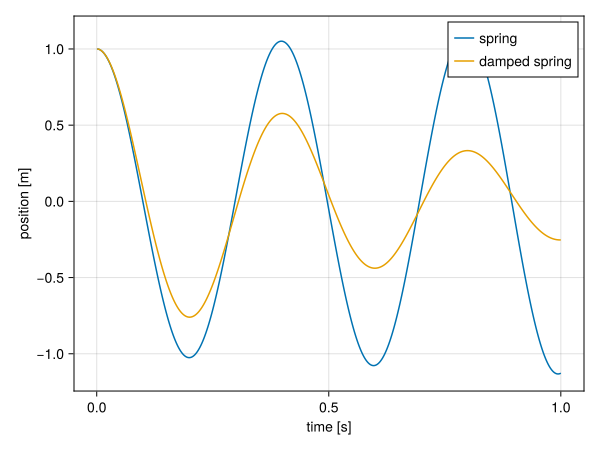
Compared to @compose
What stays the same:
- Components are modules. As with
@compose, a component is a module, and the structs it defines are merged with those of the same name in other components. - Diamonds and transitive closure. A model names only the components it needs directly, and shared dependencies appear once.
- A flat user interface. Models are still constructed with flat keyword arguments, and code still reads
input.t_step.
What changes:
- Parts keep their types. A record is not merged into a single struct: each part keeps its own type, so behaviour is selected by dispatch instead of
@for_eachover module names. - Substitution through roles. A component can depend on a role, and any component implementing it fills the role for every dependant at once (see #4).
- No code generation from stored syntax. There is no
Core.evalof parent ASTs, and no copiedusingstatements, so components can be defined anywhere (see #16). - Ordinary Julia tooling applies. Struct definitions are written out where they are defined, so they can be found, documented and revised like any other struct.
Limitations shared with @compose:
- Field names must be unique across a record. Forwarding needs to know which part owns a name, just as
@composeneeds it to merge fields.record_typechecks this. - Dependency order is the only order.
step!runs components in dependency order. A model that needs a different order defines its ownstep!, as@composemodels do now.
Both depend on which components end up in the model, so they can only be checked or resolved when the model is assembled.
Design notes
Roles as traits
An earlier version of this prototype used subtyping as the only way to fill a role. Since a Julia struct has one supertype, chosen where the struct is defined, a component could fill only one role. Now that a component is a module, rather than one of its structs, subtyping doesn't apply at all, and role membership is the trait implements(::Val{M}, R) (see Requirements and roles). It can be extended anywhere, and a component can fill any number of roles. The example One component, two roles shows it in use. Two consequences of this design:
implementsis user-extensible, so it can't be called from the generator of a@generatedfunction. Roles are therefore resolved inrecord_typeand stored in the composite type as a role map. A role that no component in the model requires is still found bycomponent, but at run time.- Methods can't dispatch on a role (
value(s::AbstractSource, model)matches no part). Where that's needed, the usual Holy-trait pattern applies. In practice components find each other throughcomponent(model, Role).
Components as modules
An earlier version of this prototype identified a component by a type, its Input struct. That gave Input a special place: it was the component's identity, and the only record that could be composed at the top level. Other structs, like Facies, could only be composed as items inside an Input, through an extra protocol. Identifying a component by its module, as @compose does, removes both: all structs in a component are treated alike, and a record is any struct name that components share. The state of the spring example could be composed with record_type(:State, Spring) in the same way, though there map_components is more convenient, since each part of the state is computed from the input.
The cost is that a component is always a whole module, that roles can't be filled by subtyping, and that looking up a part by its module is only type-stable when the module is passed as Val(M) (see Composite values). The @component macro of the next chapter makes components written this way more concise.